Why the Best Product Doesn’t Always Become the Strongest Brand
A few years ago, new obesity treatments were primarily discussed within pharmaceutical and scientific circles.
Today, that’s no longer the case.
GLP-1 medication and other obesity treatments have become part of the public conversation. They appear daily in news outlets, podcasts, social media, and conversations between consumers.
This shift extends far beyond healthcare.
As soon as a complex innovation becomes part of the public conversation, the role of branding, positioning, and communication changes as well. It’s a challenge we’re seeing more and more often among innovative companies—and one we regularly encounter with our own clients.
The science doesn’t change. The audience does.
Many biotech, healthcare, and life sciences companies are built on a strong scientific foundation. Naturally, their focus is on research, validation, safety, and efficacy.
But as markets mature, so do the audiences that need to understand the story.
Not just physicians, researchers, or specialists.
Also patients, investors, partners, employers, journalists, policymakers, and future employees.
And that’s where a new challenge often emerges.
How do you explain complex science without losing its depth?
How do you make advanced research understandable without oversimplifying it?
And how do you build trust with people who don’t share your expertise?
Why Branding Matters More Than Ever
Many innovative companies still think of branding as a logo, a website, or a visual identity.
In reality, branding is something much broader.
Branding helps people understand.
It translates a complex organisation into a clear and compelling story.
Especially in industries driven by science, technology, and innovation.
Because people rarely make decisions based on scientific publications alone.
Instead, they form opinions based on:
- what they understand
- what they remember
- what they trust
And that’s exactly where positioning plays a crucial role.
Four Companies. One Market. Four Different Stories.
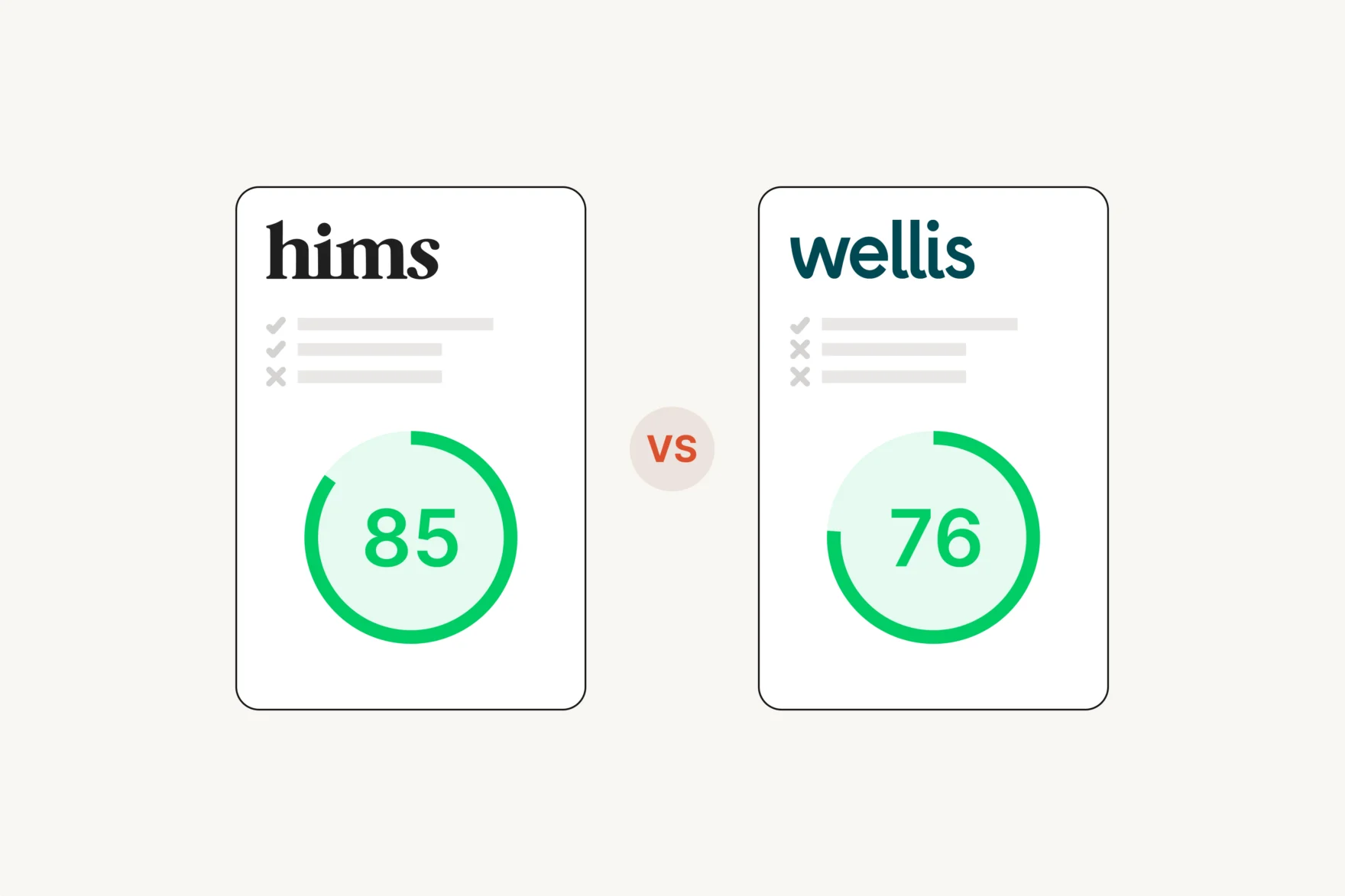
To explore how organisations approach this challenge, we analysed four brands operating in the medically supported weight-loss market:
- Goodweigh
- Wellis
- Yazen
- Hims
Not to evaluate the quality of their medical treatments.
But to understand how they translate a medical topic into a brand story that people understand and trust—and how they differentiate themselves from one another.
During our analysis, we assessed each brand across five key dimensions:
- Positioning
- Trust
- Messaging
- Offer clarity
- Brand experience
What immediately stood out was that although all four companies operate in the same market, they tell fundamentally different stories.
Hims: A Strong Consumer Brand
Hims doesn’t position itself primarily as a provider of obesity medication. Instead, it presents itself as a modern consumer health brand, focusing on simplicity, convenience, and a seamless digital experience.
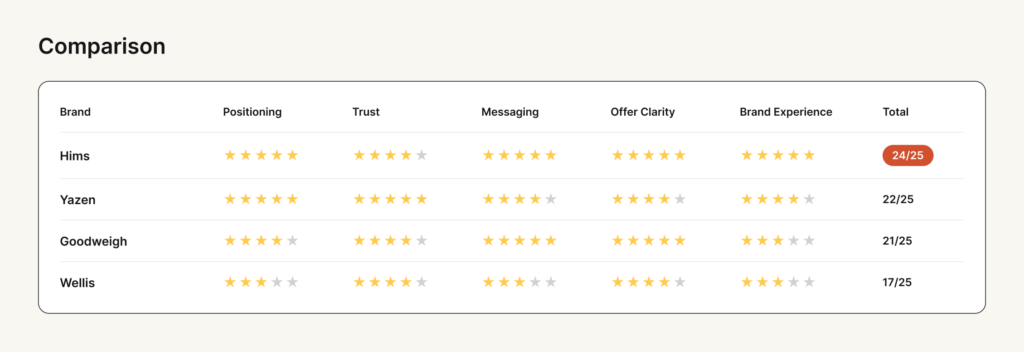
Positioning (5/5)
Exceptionally clear. Hims deliberately positions itself as a consumer brand rather than a traditional healthcare provider. The brand feels approachable, modern, and easy to engage with.
Trust (4/5)
The medical foundation is clearly present but doesn’t dominate the experience. Trust is built through a professional customer journey, transparent processes, and a highly consistent brand identity.
Messaging (5/5)
Short, clear, and easy to understand. Rather than explaining the science behind GLP-1 medication, the messaging focuses on the benefits for the user.
Offer clarity (5/5)
Visitors immediately understand which treatments are available, how the process works, and what their next step should be.
Brand experience (5/5)
From the tone of voice and photography to the interface design, everything feels like part of one cohesive brand. Hims clearly differentiates itself from a traditional healthcare provider.
Yazen: Guidance as a competitive advantage
While many providers focus primarily on medication, Yazen tells a broader story centred around long-term behavioural change and personal guidance.
Positioning (5/5)
Yazen positions itself as a healthcare partner rather than simply a medication platform. This creates a clear and credible place in the market.
Trust (5/5)
Doctors, dietitians, psychologists, and coaches all play a visible role throughout the customer journey, reinforcing the brand’s medical credibility.
Messaging (4/5)
The communication feels warm, human, and empathetic. Considerable attention is given to life beyond the treatment itself, although the core proposition could become clearer slightly earlier on some pages.
Offer clarity (4/5)
The programme is explained well but requires visitors to spend a little more time reading before fully understanding how it works.
Brand experience (4/5)
Warm, professional, and healthcare-oriented. Less consumer-focused than Hims, but entirely consistent with its positioning.
Goodweigh: Clarity and Results
Goodweigh takes an accessible approach that helps visitors quickly understand what the programme offers and the results they can expect.
Positioning (4/5)
The brand focuses on medically supervised weight loss combined with coaching. It’s clear and credible, although less distinctive than some international competitors.
Trust (4/5)
Medical guidance and expertise are communicated throughout the website, but could play a more prominent role in the overall brand story.
Messaging (5/5)
Clear language, tangible benefits, and straightforward explanations make the proposition easy to understand.
Offer Clarity (5/5)
One of Goodweigh’s strongest qualities. Visitors immediately understand the process, what’s included, and what the costs are.
Brand Experience (3/5)
Functional and easy to navigate, but visually and in terms of brand personality less distinctive than Hims or Yazen.
Clear language, tangible benefits, and straightforward explanations make the proposition easy to understand.
Offer Clarity (5/5)
One of Goodweigh’s strongest qualities. Visitors immediately understand the process, what’s included, and what the costs are.
Brand Experience (3/5)
Functional and easy to navigate, but visually and in terms of brand personality less distinctive than Hims or Yazen.
Wellis: A Broader Digital Health Platform
Wellis takes a broader positioning, presenting weight management as one part of a wider digital healthcare platform.
Positioning (3/5)
The broader proposition makes the platform versatile, but also means its weight-loss offering is less sharply defined.
Trust (4/5)
Medical credibility is well established through its emphasis on physicians and professional guidance.
Messaging (3/5)
The communication is clear but primarily functional. The brand story lacks the emotional differentiation that helps brands become memorable.
Offer Clarity (4/5)
Services are presented clearly, although the broader range of healthcare offerings requires visitors to spend slightly more time exploring the platform.
Brand Experience (3/5)
Professional and trustworthy, but less distinctive as a brand. As a result, Wellis is less memorable than some of its competitors.
What This Audit Reveals
Although all four companies operate in the same market, one thing immediately stood out.
None of these brands are really selling medication. They’re selling an outcome. A healthier life. Greater control. More confidence. A sustainable solution to a problem that many people have struggled with for years. The product may be similar, but the story surrounding it is fundamentally different. While Hims focuses on accessibility and brand experience, Yazen differentiates itself through medical guidance and long-term support. Goodweigh emphasises clarity and results, while Wellis positions itself as a broader digital healthcare platform.
This is interesting because it demonstrates what happens as markets mature.
In the early stages, competition revolves around technology, innovation, and product features. But as more competitors enter the market and audiences become increasingly familiar with the category, the conversation shifts. People no longer focus on what a product does. They focus on why it matters. That’s the moment positioning becomes a true competitive advantage. The companies that succeed aren’t always those with the most advanced technology. More often, they’re the companies that explain their value most clearly and build the strongest trust.
The Biggest Lesson: People Don’t Buy Complexity
One of the biggest misconceptions in innovation-driven industries is that more information automatically leads to greater understanding. In reality, the opposite is often true. The more complex the story becomes, the harder it is for people to understand why it matters.
Strong brands solve this problem. Not by removing the science. But by translating complex expertise into human relevance. They don’t just answer the question: “How does it work?”
They answer the question that matters most: “Why should I care?”
Why This Matters for Innovation-Driven Companies
At Mars, we work with organisations operating in complex, innovation-driven industries from biotech and healthtech to deeptech and other knowledge-intensive sectors.
What these organisations have in common is that their biggest challenge is rarely the product itself.
More often, the challenge lies in explaining its value. Because if people don’t understand what you do, it’s difficult to build trust. And without trust, sustainable growth becomes much harder. That’s why we believe branding isn’t about simplifying complex science. It’s about making it understandable. So innovation isn’t just developed. It’s understood. And ultimately embraced by the people it’s designed to serve.